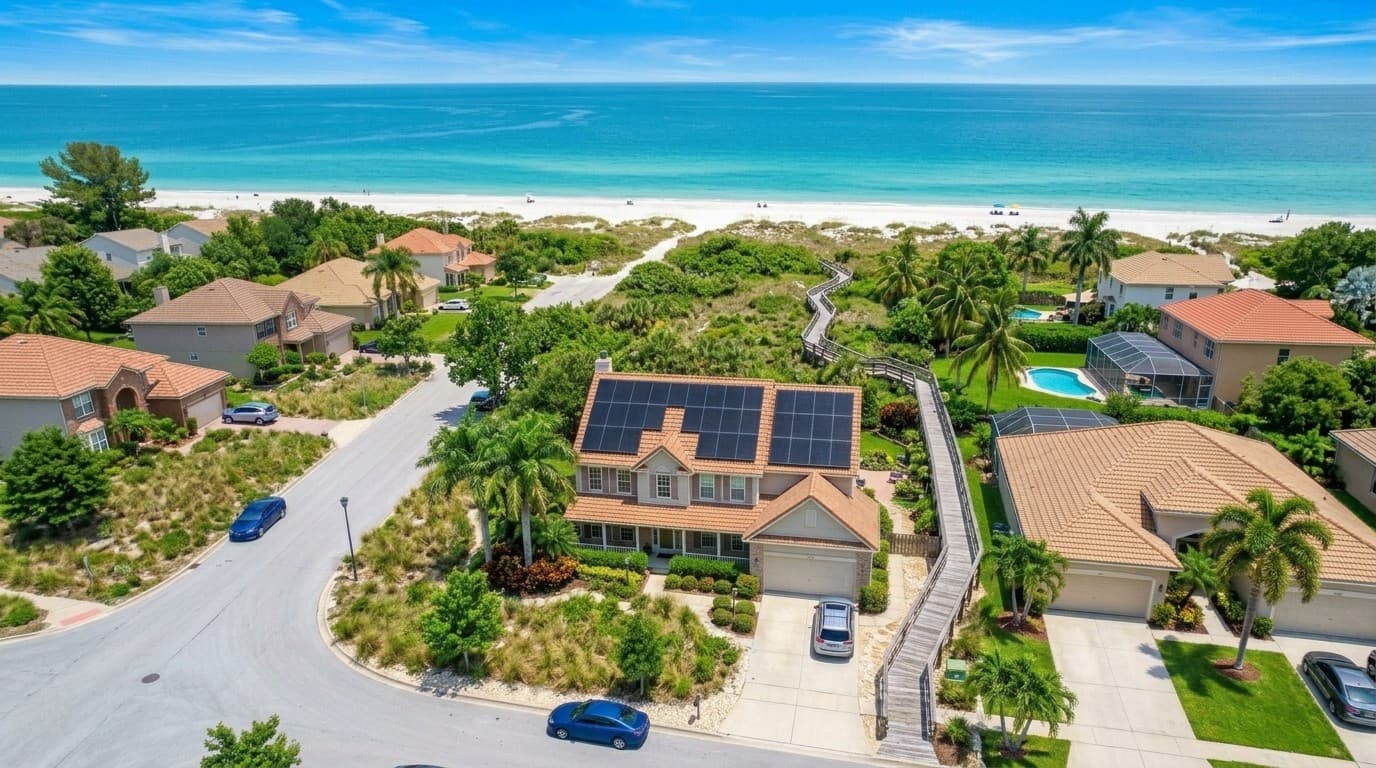
Solar panels in Charlotte County, FL
Compare solar costs, payback and local permit rules across 5 Charlotte County towns served by FPL, then get free, no-obligation quotes.
Free, no-obligation quotes. Savings vary by home and utility. $0-down offers are leases or loans and are subject to approval.
By the FL Solar Deals Editorial Team · Updated October 2026 · How we research
Quick answer
Is solar worth it in Charlotte County, FL?
For many homes, yes. With a $200 monthly bill, we estimate a system costs about $25,900 in Charlotte County and pays for itself in about 13 years on an unshaded, south-facing roof, because FPL credits exported solar at the full retail rate.
How does solar compare across Charlotte County towns?
| Town | Median home value | Owner-occupied |
|---|---|---|
| Babcock Ranch | n/a | n/a |
| Harbour Heights | n/a | n/a |
| Port Charlotte | $269,900 | 83% |
| Punta Gorda | $518,100 | 82% |
| Rotonda | n/a | n/a |
Panels across Charlotte County produce about 1,520 kWh per kW a year, so the solar estimate is the same for every town: about $25,900 and payback in about 13 years. What differs is the housing, below.
Estimates for a cash purchase on an unshaded, south-facing roof. Home values and ownership rates are U.S. Census Bureau American Community Survey 5-year estimates; n/a means no Census figure was available. How we estimate
What should Charlotte County homeowners know about solar?
- In unincorporated Charlotte County, including Port Charlotte and Rotonda, the county's Community Development department issues solar permits. For ground-mounted arrays, the county asks for engineering of both the racking and the foundation.
- Since December 2024, Charlotte County adds an extra review before trade permits are issued on properties flagged as storm-damaged.
- The morning after Hurricane Milton in October 2024, about 80,700 of FPL's 138,410 Charlotte County customers (58%) were without power, per the Public Service Commission.
- FPL's 2025 report to the Public Service Commission lists 5,841 customer-owned solar systems on its lines in Charlotte County, 911 of them connected in 2025, by our count. See Florida solar by county.
Sources: Charlotte County: Residential solar photovoltaic permits; Charlotte County: Permitting process for trade permits on storm-damaged properties (Dec. 2024); Florida PSC: Hurricane Milton outage report, Oct. 10, 2024, 9 a.m.; Florida PSC: FPL interconnection and net metering report for 2025 (Apr. 2026)
What do Charlotte County towns require for solar?
Permits and zoning rules are set town by town. Highlights from each town's own rules:
- Babcock Ranch: A 2014 settlement among FPL, Lee County Electric Cooperative and the Babcock Ranch special district made FPL the electric provider for the whole community, which a 1965 territorial agreement had split between the two utilities.
- Harbour Heights: Harbour Heights homeowners have their own Charlotte County assessment districts for streets and drainage and for waterways; the waterway district pays for canal dredging and navigation markers but not seawalls.
- Port Charlotte: FPL is burying neighborhood power lines serving about 2,600 customers in Port Charlotte. Since 2021 it has moved 247 neighborhood lines underground in Charlotte County, and it says those underground lines performed five to 14 times better than overhead ones during Debby, Helene and Milton in 2024.
- Punta Gorda: Hurricane Ian made landfall south of Punta Gorda in September 2022 as a Category 4 storm with 145 mph winds. All power in Punta Gorda went out, and two days later about 100,800 of FPL's 126,690 Charlotte County customers were still without it.
- Rotonda: Rotonda West is deed-restricted: the Rotonda West Association has to approve a residential modification form before work starts, and owners still need Charlotte County permits too. Under Florida law (s. 163.04) an association can choose where panels go but can't ban them.
Each town page has the full details and sources.
Will solar raise my Charlotte County property taxes?
No. Under Florida law (s. 193.624), the value a solar system adds to a home isn't counted in its assessed value. If you're unsure whether anything needs to be filed, ask the Charlotte County Property Appraiser.
Solar equipment is also exempt from Florida sales tax, so it's already left out of the installed price.
How does solar work with FPL in Charlotte County?
FPL credits the solar you send to the grid as a kWh credit at the full retail rate. Unused credits roll forward for up to 12 months, and anything left at year-end is paid out at only a few cents per kWh, so systems are sized to cover a year of use. Solar can't take a bill below the monthly minimum ($30 at FPL).
See the full FPL solar guide.
Choosing a company? Check each installer's Florida license, compare at least two quotes and run them through our solar quote checker.
Charlotte County solar FAQ
Which electric utility serves Charlotte County?
The towns we cover in Charlotte County are served by FPL, which credits exported solar at the full retail rate under Florida's net metering rule. Some addresses are on a city-owned utility or co-op, so check your bill.
How long does solar take to pay back in Charlotte County?
For an unshaded home with a $200 monthly bill, we estimate payback of about 13 years in Charlotte County, paying cash with no rebate.
Will solar raise my property taxes in Charlotte County?
No. Florida law keeps the value that solar adds to a home out of its property tax assessment. Ask the Charlotte County Property Appraiser if you're unsure whether anything needs to be filed.
Get a free solar quote for your Charlotte County home
Free, no-obligation quote from a trusted Florida solar partner.