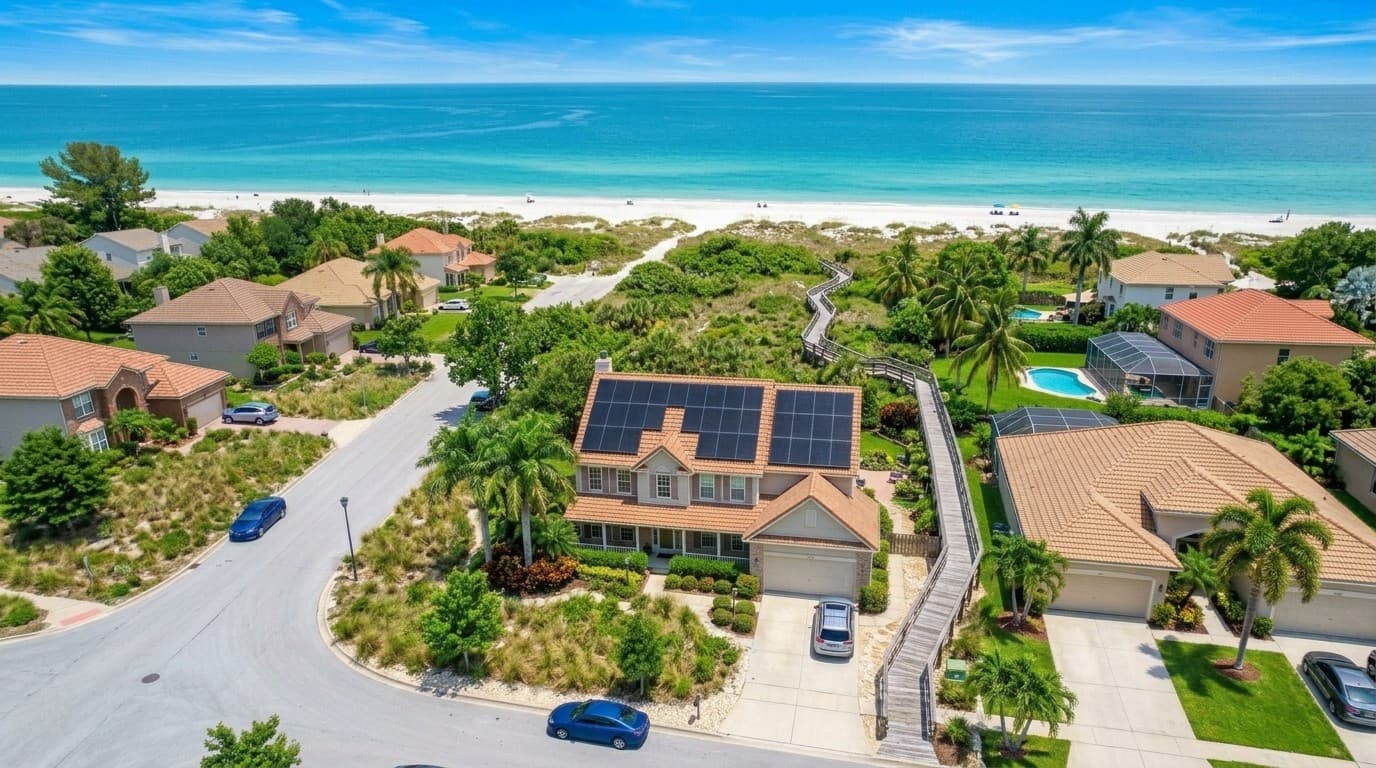
Solar panels in Miami-Dade County, FL
Compare solar costs, payback and local permit rules across 29 Miami-Dade County towns served by FPL, then get free, no-obligation quotes.
Free, no-obligation quotes. Savings vary by home and utility. $0-down offers are leases or loans and are subject to approval.
By the FL Solar Deals Editorial Team · Updated October 2026 · How we research
Quick answer
Is solar worth it in Miami-Dade County, FL?
For many homes, yes. With a $200 monthly bill, we estimate a system costs about $25,900 in Miami-Dade County and pays for itself in about 12.8 years on an unshaded, south-facing roof, because FPL credits exported solar at the full retail rate.
How does solar compare across Miami-Dade County towns?
| Town | Median home value | Owner-occupied |
|---|---|---|
| Biscayne Park | $674,300 | 78% |
| Coral Gables | $1,089,900 | 65% |
| Country Walk | $489,400 | 83% |
| Cutler Bay | $472,700 | 70% |
| Golden Beach | $2 million or more | 100% |
| Hialeah Gardens | $319,200 | 60% |
| Kendall | n/a | n/a |
| Key Biscayne | $1,575,300 | 67% |
| Miami | n/a | n/a |
| Miami Beach | n/a | n/a |
| Miami Gardens | n/a | n/a |
| Miami Lakes | $626,400 | 60% |
| Miami Shores | $864,400 | 88% |
| Miami Springs | $560,800 | 61% |
| North Miami | $326,300 | 43% |
| Olympia Heights | n/a | n/a |
| Palm Springs North | n/a | n/a |
| Palmetto Bay | $879,700 | 78% |
| Pinecrest | $1,406,400 | 83% |
| Princeton | $386,000 | 71% |
| Redland | n/a | n/a |
| Richmond Heights | n/a | n/a |
| South Miami | $829,400 | 60% |
| Surfside | $881,700 | 74% |
| Tamiami | n/a | n/a |
| The Crossings | n/a | n/a |
| The Hammocks | $437,700 | 61% |
| West Miami | $436,700 | 54% |
| Westchester | $473,300 | 68% |
Panels across Miami-Dade County produce about 1,540 kWh per kW a year, so the solar estimate is the same for every town: about $25,900 and payback in about 12.8 years. What differs is the housing, below.
Estimates for a cash purchase on an unshaded, south-facing roof. Home values and ownership rates are U.S. Census Bureau American Community Survey 5-year estimates; n/a means no Census figure was available. How we estimate
What should Miami-Dade County homeowners know about solar?
- Miami-Dade is in Florida's High-Velocity Hurricane Zone. The county's solar permit guidance asks for signed and sealed drawings and proof that exposed panels meet the zone's wind loads, so ask your installer which product approvals their racking carries.
- A 2022 county ordinance sets the minimum freeboard in flood hazard areas at the stricter of 1 foot above base flood elevation or the Florida Building Code minimum, worth knowing when choosing where a battery or inverter goes.
- Miami-Dade County co-funded a Solar United Neighbors solar co-op that closed to new members on September 15, 2025.
- FPL's 2025 report to the Public Service Commission lists 11,850 customer-owned solar systems on its lines in Miami-Dade County, 1,568 of them connected in 2025, by our count. See Florida solar by county.
Sources: Miami-Dade County: Solar systems permit guidelines; Miami-Dade County: Flood freeboard ordinance (2022); Solar United Neighbors: Miami-Dade solar co-op; Florida PSC: FPL interconnection and net metering report for 2025 (Apr. 2026)
What do Miami-Dade County towns require for solar?
Permits and zoning rules are set town by town. Highlights from each town's own rules:
- Biscayne Park: Biscayne Park's Planning and Design Review Board reviews exterior work such as roof replacements, and solar panel permits have appeared on its agendas, so plan for design review as well as a building permit.
- Coral Gables: Coral Gables waives city permit fees for installing solar panels, and solar batteries are on its list of work that qualifies.
- Country Walk: Hurricane Andrew destroyed about 90% of Country Walk's roughly 1,700 homes in August 1992.
- Cutler Bay: The Town of Cutler Bay's own Building Department issues permits from the Town Center at 10720 Caribbean Blvd., and contractors must register with the town before working there.
- Golden Beach: Golden Beach paid to move its power lines underground with a voter-approved bond. Even so, during flooding in June 2024, residents lost power for more than 24 hours, and the town manager said that for a community with underground power, losing it that long was absolutely wrong. A battery covers outages that buried lines don't prevent.
- Hialeah Gardens: Hialeah Gardens has its own Building Department next to City Hall at 10001 N.W. 87th Avenue, so permits come from the city, not Miami-Dade County or the City of Hialeah.
- Kendall: Kendall is unincorporated, so Miami-Dade County issues solar permits.
- Key Biscayne: The Village of Key Biscayne posts its own Solar Systems Permit Checklist. It asks for signed and sealed drawings with design calculations, the roof's wind uplift zone, the Florida Solar Energy Center (FSEC) certification form for the system and an owner's solar disclosure form.
- Miami: The City of Miami says its solar permits are both expedited and free.
- Miami Beach: Miami Beach waives all building permit fees for solar (photovoltaic) work under Ordinance 2017-4153, though a permit is still required.
- Miami Gardens: Miami Gardens publishes its own solar permit guideline: a rooftop system needs both a building and an electrical application, with a list of the minimum design information required.
- Miami Lakes: The Town of Miami Lakes lists solar panel permits at 5 to 7 business days. Applications need signed and sealed plans with wind load calculations, a solar disclosure form and an HOA affidavit, and owner-builders aren't eligible.
- Miami Shores: Miami Shores' 2025 solar submittal checklist says online applications always use the Solar permit category, with a separate permit application for each contractor.
- Miami Springs: FPL's underground-lines pilot in Miami Springs covered 47 neighborhood power lines, about 6.5 miles of overhead line and 1,042 customers. FPL updated the City Council in September 2025 and held a town hall that October, and some residents have signed easements for the work.
- North Miami: North Miami's own Building Department issues permits, and since 2021 it has taken applications, payments, digital plans and contractor registration online.
- Olympia Heights: Tropical Park, the 275-acre Miami-Dade County park at 7900 SW 40th Street in Olympia Heights, is where FPL installed solar trees that shade visitors while making power, under its SolarNow program.
- Palm Springs North: On April 7, 2026, an EF0 tornado with peak winds near 85 mph cut a half-mile path through Palm Springs North, damaging roofs and downing trees and power poles; FPL said about 200 homes lost power.
- Palmetto Bay: After Hurricane Irma in 2017, nearly half of Palmetto Bay was still without power days later, and some residents went 12 days without it. A battery can keep essentials running through an outage like that.
- Pinecrest: Since 2018, FPL's undergrounding program has moved more than 41 miles of Pinecrest's neighborhood power lines underground, with another project in design in 2026.
- Princeton: Princeton was named by lumberman Gaston Drake for his alma mater, Princeton University; his sawmill supplied Miami, the Florida Keys and Cuba until the local pine ran out in the 1920s.
- Redland: The Redland sits outside Miami-Dade's Urban Development Boundary, drawn in the 1980s to protect farmland and wetlands that recharge the aquifer, and many homes sit on five-acre lots with room for a ground-mounted array.
- Richmond Heights: Richmond Heights was founded in 1949 by Capt. Frank Crawford Martin, a former Pan Am pilot, as a planned community for Black World War II veterans and their families; the state calls it the first of its kind in South Florida.
- South Miami: In July 2017 South Miami became the first Florida city to require rooftop solar on new single-family homes and townhouses, and on renovations that grow a home's footprint 75% or more: 175 square feet of panels per 1,000 square feet of roof, or 2.75 kW per 1,000 square feet of living space, whichever is less. Shaded homes can ask for an exemption; confirm the current rule with the city.
- Surfside: Surfside is moving its overhead power lines underground in three areas. As of August 2025, the town expected the north area to finish in 2027, the central area to run from 2026 to 2028 and the south area from 2027 to 2029. Buried lines cut storm damage, but a battery is what keeps your home running in a wider outage.
- Tamiami: After floods in 1999 and 2000, the South Florida Water Management District built the Tamiami Canal flood protection project, centered on a 900-acre emergency detention basin west of SW 137th Avenue off Tamiami Trail.
- The Crossings: The Crossings takes in the neighborhoods of Devon Aire and Calusa, and Miami-Dade County issues its building and solar permits.
- The Hammocks: The Hammocks is one master association over 18 neighborhood associations and 22 subdivisions, about 6,500 homes, its management company says, so most homes need association review before exterior work like solar; Florida law lets an association pick panel placement but not ban solar.
- West Miami: West Miami is its own city, incorporated in 1947 on less than three-quarters of a square mile between Tamiami Trail and Coral Way, so its own Building Department, not Miami-Dade County or the City of Miami, issues permits.
- Westchester: Westchester is unincorporated, and residents beat back a 2022 push by a county commissioner to make it a city, so Miami-Dade County still handles building and solar permits here.
Each town page has the full details and sources.
Will solar raise my Miami-Dade County property taxes?
No. Under Florida law (s. 193.624), the value a solar system adds to a home isn't counted in its assessed value. If you're unsure whether anything needs to be filed, ask the Miami-Dade County Property Appraiser.
Solar equipment is also exempt from Florida sales tax, so it's already left out of the installed price.
How does solar work with FPL in Miami-Dade County?
FPL credits the solar you send to the grid as a kWh credit at the full retail rate. Unused credits roll forward for up to 12 months, and anything left at year-end is paid out at only a few cents per kWh, so systems are sized to cover a year of use. Solar can't take a bill below the monthly minimum ($30 at FPL).
See the full FPL solar guide.
Choosing a company? Check each installer's Florida license, compare at least two quotes and run them through our solar quote checker.
Miami-Dade County solar FAQ
Which electric utility serves Miami-Dade County?
The towns we cover in Miami-Dade County are served by FPL, which credits exported solar at the full retail rate under Florida's net metering rule. Some addresses are on a city-owned utility or co-op, so check your bill.
How long does solar take to pay back in Miami-Dade County?
For an unshaded home with a $200 monthly bill, we estimate payback of about 12.8 years in Miami-Dade County, paying cash with no rebate.
Will solar raise my property taxes in Miami-Dade County?
No. Florida law keeps the value that solar adds to a home out of its property tax assessment. Ask the Miami-Dade County Property Appraiser if you're unsure whether anything needs to be filed.
Get a free solar quote for your Miami-Dade County home
Free, no-obligation quote from a trusted Florida solar partner.