Quick answer
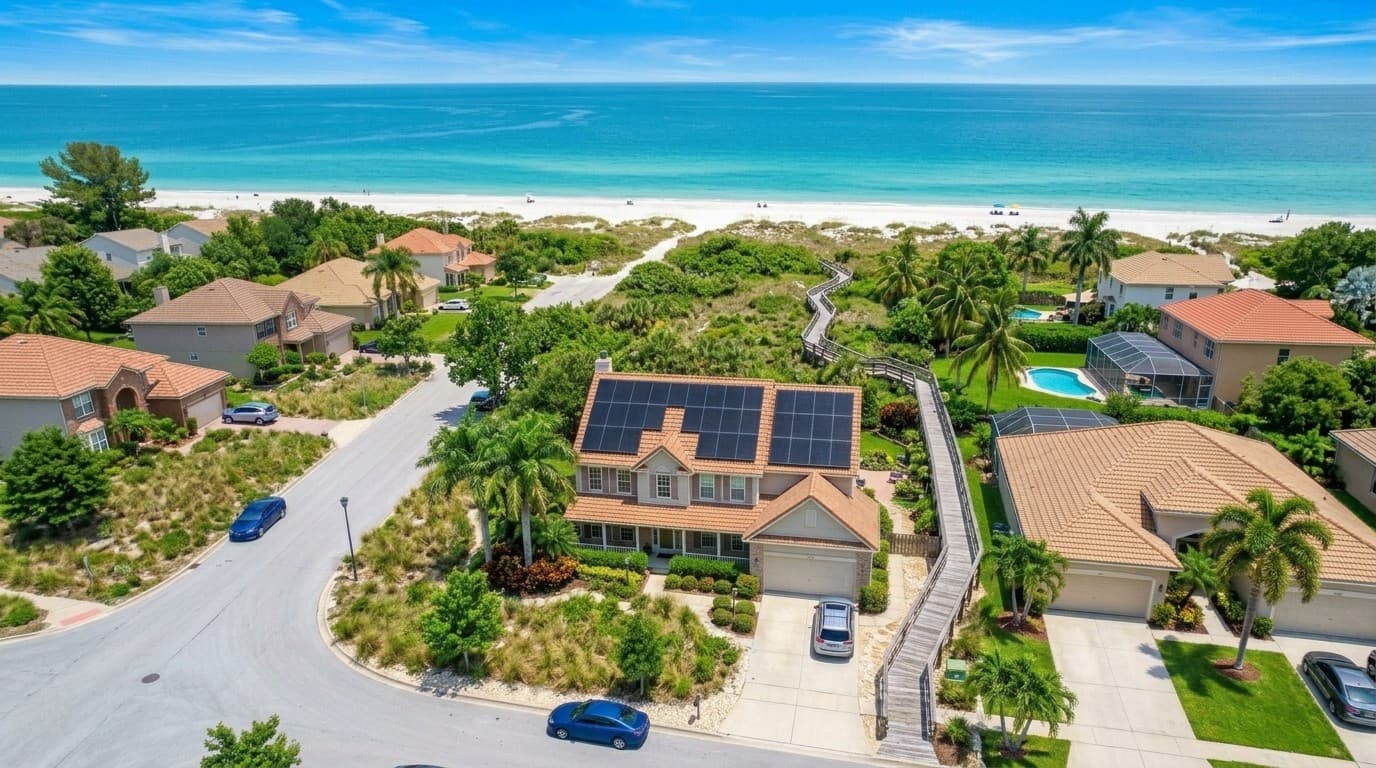
Usually, if you own the system. Zillow found Florida homes with solar sold for about 4% more in 2019, and newer estimates run higher. Leased panels add little or nothing, because appraisers for Fannie Mae loans can't count them. Florida also keeps the added value out of your property tax assessment, so a higher home value doesn't raise your tax bill.
How much does solar add to a Florida home's value?
Estimates vary, but owned solar has been tied to higher sale prices in every major study.
| Study | Homes studied | Premium found |
|---|---|---|
| Zillow (2019) | Listings sold March 2018 to February 2019 | 4.1% nationally; 4% in Florida (about $9,454 on the median home); 4.6% in Orlando |
| Berkeley Lab (2015) | About 22,000 sales in 8 states, including Florida | About $4 per watt, or about $15,000 for a typical 3.75 kW system |
| Fannie Mae and Berkeley Lab (2021) | Sales in 4 states | Higher prices for owned systems, though the premium fell over time |
| SolarReviews (2025) | 400+ paired listings in 36 states | 6.9%, about $25,000 |
The SolarReviews figure comes from a small industry study, and the Zillow and Berkeley Lab data are several years old, so treat any single number as a rough guide. Solar pays for itself mainly through bill savings; a higher sale price is a bonus. See is solar worth it in Florida.
Does it matter whether the panels are owned or leased?
Yes, more than anything else. Fannie Mae's appraisal guidance says that if the panels are leased or under a power purchase agreement, the appraiser may not include their value. Panels bought with cash, or with a loan that isn't secured by the panels, can be valued like any other feature of the home.
If ownership is unclear, Fannie Mae says the panels get no value unless the lender runs a UCC personal property search. The 2021 Fannie Mae and Berkeley Lab study found that homes with panels the owner didn't own showed no value or slightly lower values.
Will solar raise my property taxes in Florida?
No. Under s. 193.624 of the Florida Statutes, the value that solar panels, inverters and battery storage add to a home can't be counted in the property appraiser's assessment. That rule covers home installations since 2013. Changes made in 2017, mostly for business property, are set to expire at the end of 2037, but the home exclusion isn't scheduled to end. So buyers get the higher value, and you don't pay more tax in the meantime.
How do I get credit for solar when I sell?
- Gather proof that you own the system: the purchase contract, paid-off loan or lien release, and the permits and final inspection.
- Share the system size, the equipment and warranties, and at least a year of production and electric bills.
- Ask your agent to give the appraiser the Appraisal Institute's Residential Green and Energy Efficient Addendum, a form for recording solar and other energy features.
- List the solar in the listing description so buyers and appraisers notice it.
A home battery is worth listing too, especially for buyers who lived through long outages, but no solid study has measured how much a battery adds to a sale price.
What if my solar was financed with PACE?
PACE loans are repaid on your property tax bill and put a lien on the home. Florida law requires the seller to disclose an unpaid PACE assessment at or before the time the buyer signs the contract.
Fannie Mae won't buy a mortgage on a home with a PACE loan that takes priority over the mortgage, and FHA said in 2017 it would stop insuring mortgages on homes with PACE assessments. In practice, many sellers have to pay off PACE at closing.
Florida tightened its PACE law in 2024 (SB 770), adding ability-to-pay checks and contractor oversight. A federal rule that treats PACE like other mortgage credit took effect March 1, 2026; a federal court in Florida upheld it in February 2026, and an appeal is pending.
What if I'm selling a home with leased solar?
Florida Realtors advises sellers to confirm whether panels are owned, financed or leased, and to settle payoff or transfer terms before signing a sales contract. With a lease, the buyer has to qualify with the solar company to take it over, or you pay it off.
Florida Realtors has also warned that many title companies don't search for the UCC filings that solar companies record, so a lien can be missed until late in the sale. Have the payoff or transfer paperwork ready before you list.
Does my roof's age affect selling a home with solar?
It can. Under Florida's 2022 roof law, insurers can't refuse to cover a roof under 15 years old just because of its age, and an older roof that passes an inspection showing at least 5 years of life left gets the same protection. Buyers need insurance to close, so an old roof under panels can become an issue.
Replacing a roof under existing panels means removing and reinstalling them, which adds cost. If your roof is near the end of its life, replace it before going solar. See solar panels on a tile roof and solar and home insurance in Florida.
Sources
- Solar Power World: Zillow analysis finds solar homes sell for 4% more (2019)
- CNBC: Solar power can boost a home's value in these 10 states (Zillow, 2019)
- RISMedia: Zillow solar premium report, by state and metro (Apr. 2019)
- Berkeley Lab: Selling into the Sun, sale prices of homes with owned solar (2015)
- Fannie Mae and Berkeley Lab: Solar home premiums (2021)
- SolarReviews: Solar home value report (2025)
- Fannie Mae: Appraising properties with solar panels
- Florida Statutes s. 193.624: Assessment of renewable energy source devices
- Florida Statutes s. 193.624 (2026): Renewable energy source devices
- Appraisal Institute: A guide to the Residential Green and Energy Efficient Addendum
- Florida Statutes s. 163.08: Property assessed clean energy financing
- Fannie Mae Selling Guide: Property Assessed Clean Energy loans (B5-3.4-01)
- HUD: FHA to stop insuring mortgages on homes with PACE assessments (Dec. 2017)
- Florida PACE: Frequently asked questions (SB 770, 2024)
- CFPB: Residential PACE financing rule, Federal Register (Jan. 2025)
- Orrick InfoBytes: Court upholds CFPB PACE rule ahead of March 1 effective date (Feb. 2026)
- Florida Realtors: Solar panels, questions to ask before the contract (Aug. 2026)
- Florida Realtors: 7 must-dos when selling a home with solar panels (2022)
- Kin Insurance: Florida's 15-year roof rule
- Fixr: Cost to remove and reinstall solar panels
This guide is general information, not tax, legal or financial advice. Incentive programs change, so confirm current terms with your installer, your utility and a tax professional.