Quick answer
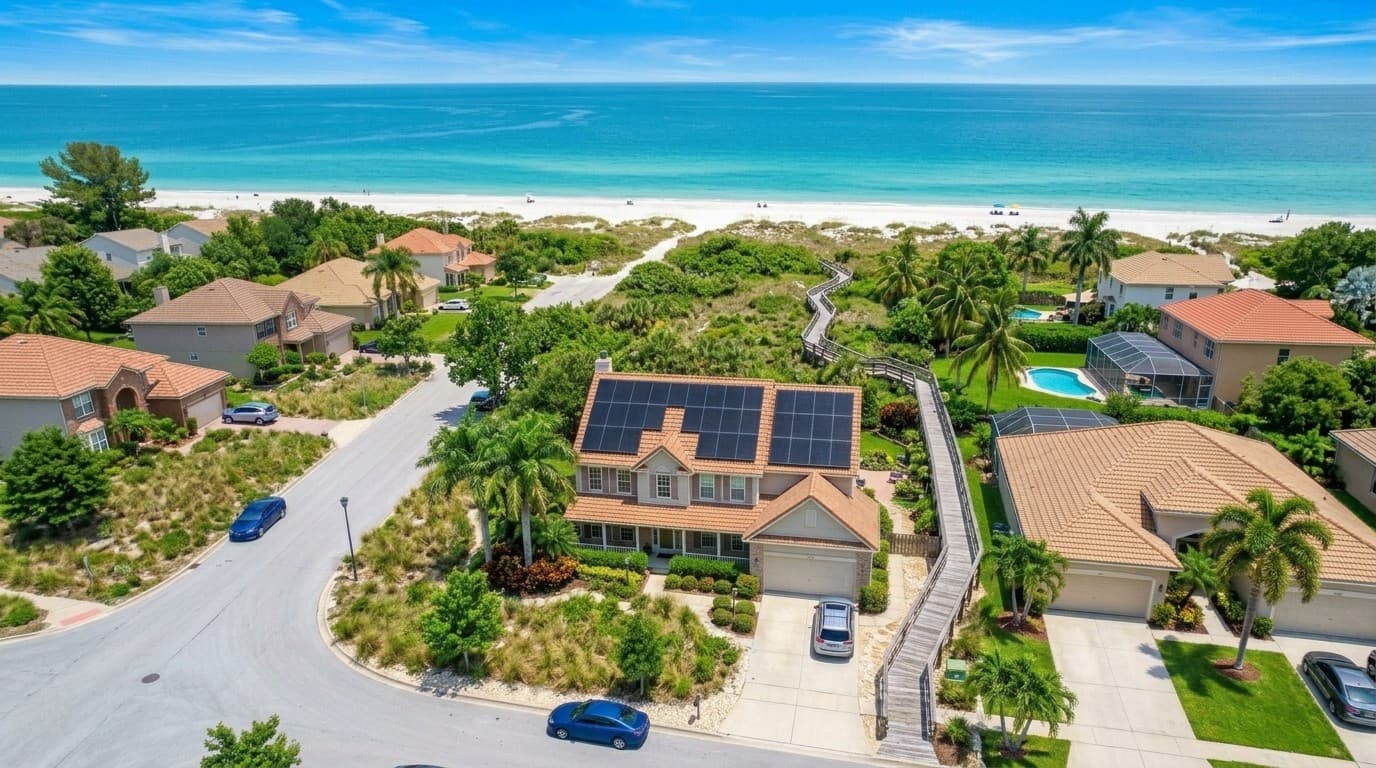
Rooftop panels usually sit above floodwater, but the inverter, battery and disconnects don't. Florida code requires electrical equipment in a flood zone to sit at or above the local flood elevation, and every major battery maker says to install out of flood reach. A submerged battery has to be replaced. In some towns the cost of solar also counts toward FEMA's 50% rule.
Can floodwater damage a solar system?
The panels are on the roof, so they're rarely underwater. The parts at risk are the ones mounted low on a wall or in the garage: the inverter, the battery, disconnects, the meter and the main panel.
The U.S. Department of Energy says any solar component that has been submerged will need to be replaced. It also points out that FEMA flood maps cover rivers, lakes and the coast but not stormwater flooding, so a home outside a mapped flood zone can still flood.
How high do the inverter and battery have to be?
Section R322.1.6 of the Florida Building Code says electrical systems, equipment and components in a flood hazard area must be at or above the required flood elevation, which your local floodplain rules set (the base flood elevation plus any local freeboard). Wiring can run lower if it meets the electrical code's wet-location rules.
Since the 8th edition of the code took effect, replacing exterior equipment that a flood damaged also has to meet that rule. Florida's Division of Emergency Management issued guidance on applying it in January 2026.
- Tesla says to install Powerwall 3 in a location that prevents damage from flooding.
- Enphase says to mount the IQ Battery 5P at a height that keeps water out, and to replace it if water has reached it.
- FranklinWH says the aPower 2 shouldn't go where flooding or standing water occurs, and to call your installer if water rises to the battery.
Florida code also limits where a battery can go inside a home. See solar battery backup for hurricanes and the best home batteries for Florida.
Does adding solar count toward FEMA's 50% rule?
It can. Under FEMA's substantial improvement rule, if improvements to a home below the flood elevation reach 50% of the building's value, the whole home has to be brought up to current flood standards, which often means elevating it.
Key West's building FAQ says that although solar may be exempt from property taxes in Florida, FEMA still considers it a building improvement. Lee County's and Pinellas County's cost breakdown forms for the 50% calculation both list solar panels and equipment.
Some places add up improvements over several years. Lee County's ordinance counts work over a five-year period, and Fort Myers Beach counts every permit pulled in the past five years. If your home sits below the flood elevation and you're also planning a remodel or storm repairs, ask your floodplain manager how solar counts before you sign.
Does flood insurance cover solar panels and batteries?
FEMA's FloodSmart site lists solar energy equipment under National Flood Insurance Program building coverage.
There's a catch for elevated homes in high-risk zones. Below the lowest elevated floor, the NFIP policy covers only a short list of items. The policy's list names pumps and tanks used in solar energy systems, but not inverters or home batteries, so equipment mounted under a raised home may not be covered. Ask your agent before choosing a spot for the battery.
Wind damage falls under your homeowners policy instead. See solar and home insurance in Florida.
Is a flooded lithium battery a fire risk?
Saltwater is the danger. After Hurricane Helene in 2024, Florida's then-State Fire Marshal confirmed 16 lithium-ion battery fires tied to storm surge, six of them in electric vehicles, and by the time Milton approached the count was nearly 50. Those warnings were about EVs, golf carts, scooters and power tools, but home batteries use lithium-ion cells too.
The Electrical Safety Foundation lists batteries among water-damaged equipment that must be replaced, not dried out. If a home battery sat in floodwater, don't turn it back on: call your installer.
What happens to my power after a flood?
Duke Energy Florida says it can't reconnect a flooded home until a licensed electrician has inspected the electrical system, and if there's damage, the repairs need sign-off from the local building department first. Tampa Electric has the same rule. If you're on FPL, ask your city or county what it requires.
A battery mounted above the water can keep running the house through an outage, but only if the home's wiring is safe. Plan the system so the battery and the circuits it backs up stay dry.
How should I plan solar in a flood zone?
- Find your flood zone and your home's elevation certificate before you get quotes.
- Ask installers where they'll mount the inverter and battery, and how high above the flood elevation.
- In a home below the flood elevation, ask your floodplain manager whether the solar cost counts toward the 50% rule, especially if you have other work planned.
- Check with your insurance agent how the equipment is covered where it will be mounted.
- Choose a battery that charges itself before a storm. See the best home batteries for Florida.
Compare quotes with the solar quote checker, and see can solar panels survive a hurricane for wind and roof questions.
Sources
- U.S. DOE: Solar systems and flooding
- Florida Building Code, Residential (8th ed., 2023): Section R322 flood-resistant construction
- Florida Division of Emergency Management: Flood provisions of the 8th edition Florida Building Code (Dec. 2023)
- Florida Division of Emergency Management: Guidance on flood-damaged equipment (Jan. 2026)
- Tesla: Powerwall 3 owner's manual, installation location
- Enphase: IQ Battery 5P owner's guide
- FranklinWH: aPower 2 system installation guide
- City of Key West: FAQ on solar and FEMA substantial improvement
- Lee County: Substantial improvement cost breakdown form (Sept. 2024)
- Pinellas County: Substantial improvement cost breakdown package (June 2024)
- Lee County: Ordinance 15-09, cumulative five-year substantial improvement
- Town of Fort Myers Beach: Substantial improvement and substantial damage
- FEMA FloodSmart: What flood insurance covers
- FEMA: NFIP Dwelling Form standard flood insurance policy
- Florida CFO: Lithium-ion battery fires after Hurricane Helene (Oct. 2, 2024)
- Florida CFO: Lithium-ion battery fire warning ahead of Hurricane Milton (Oct. 7, 2024)
- Electrical Safety Foundation: Water-damaged electrical equipment
- Duke Energy: Flooding and electrical safety
- Tampa Electric: Storm Center
This guide is general information, not tax, legal or financial advice. Incentive programs change, so confirm current terms with your installer, your utility and a tax professional.