Quick answer
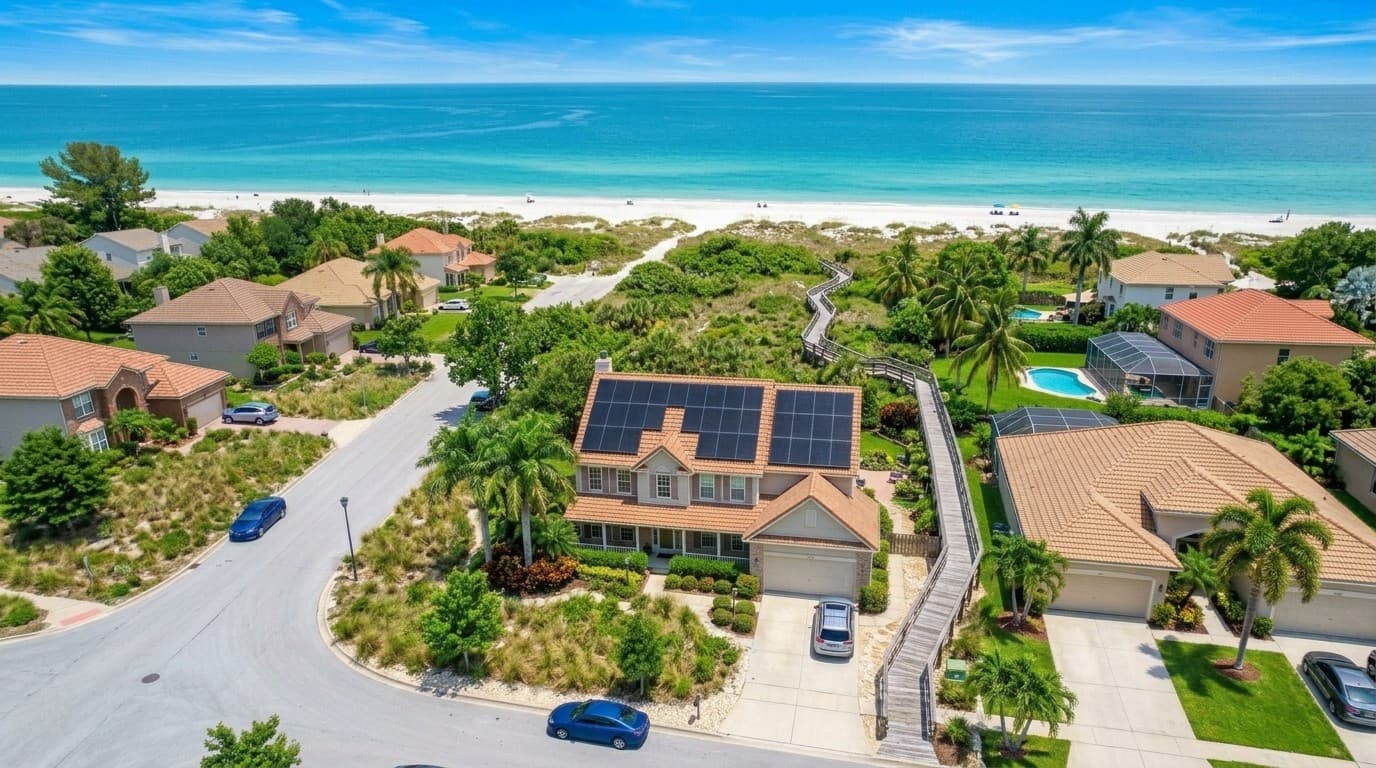
Usually, yes. Rooftop panels in Florida must be engineered for local hurricane wind loads, and FPL reported that fewer than 0.05% of its roughly 16 million solar panels were damaged by Hurricanes Helene and Milton in 2024. Most failures trace to weak clamps, old roofs or flying debris. Panels alone won't keep your power on in an outage; that takes a battery.
How did solar panels hold up in recent Florida hurricanes?
- Hurricane Ian (2022): NextEra said 38 of FPL's 50 solar sites, about 12 million panels, were exposed to storm conditions, and less than 0.3% of panels were affected, mostly at older fixed-racking sites.
- Helene and Milton (2024): NextEra reported that less than 0.05% of about 16 million panels at 66 of FPL's 88 solar sites were damaged, none of them significantly.
- Rooftop systems after Ian: a review of roof damage in Southwest Florida found that almost all newer solar panels held up well unless something hit them, such as a downed tree. Shingle and tile roofs over 10 years old fared worst.
Panels aren't indestructible. During Milton, an EF2 tornado tore a strip through Duke Energy's 45 MW solar plant in Lake Placid, though most of the plant stayed intact. Direct hits from tornadoes and flying debris can break panels on any roof.
How are rooftop solar panels built for Florida wind?
The Florida Building Code sets wind loads using the ASCE 7 standard, which since its 2016 edition has included specific rules for rooftop panels, with higher loads near roof edges. The current 8th edition of the code took effect on December 31, 2023.
- Miami-Dade and Broward (the High-Velocity Hurricane Zone): permits need engineered wind-uplift calculations, and Miami-Dade's checklist sets wind exposure category C by default.
- Racking with Florida approvals: IronRidge says its Florida-approved flush mounts are rated for up to 135 pounds per square foot of wind pressure, tested to the state's TAS 100(A) and TAS 202 standards. Unirac's SOLARMOUNT was the first racking system to earn a Miami-Dade product approval, in 2020.
- Everywhere else: plans still have to show the racking and roof attachments meet the code's wind loads for your county, and an inspector checks the finished work.
Ask your installer which racking they use, what product approval covers it and what wind speed the design is based on. See what solar costs in Florida for how wind design affects price.
Why do some solar systems fail in hurricanes?
Federal and nonprofit studies of hurricane damage in the Caribbean found that most failures came from the hardware holding panels down, not the panels themselves.
- The U.S. Department of Energy lists module clamps failing as a key failure mode: one clamp lets go, releasing a whole row of panels and causing a cascade. It recommends bolting panels through to the racking where possible instead of using top-down clamps.
- RMI found failed systems often had under-torqued bolts with no locking hardware. Systems that survived used through-bolting, locking fasteners and extra bracing, measures RMI estimated add about 5% to the cost.
- 1
Ask about attachments
How are panels attached to the racking, and is there locking hardware on the bolts?
- 2
Ask about roof penetrations
How many attachments go into the roof, how are they sealed and how long is the leak warranty?
- 3
Ask for the wind design
What wind speed and exposure category are the plans engineered for?
What should I do before a hurricane if I have solar?
- Photograph the system and your roof before the storm, so you have a record for any insurance claim.
- Check that your homeowners policy covers the panels, and know your hurricane deductible.
- If you have a battery, make sure it's fully charged and test your backup with your installer before storm season.
- Expect a grid-tied system without a battery to shut off automatically when the grid goes down. That's a safety feature, not a fault.
Panels are engineered to stay on the roof through the storm, so the main preparation is paperwork and backup power. See solar battery backup for hurricanes.
What should I do after a hurricane?
Look at the system from the ground and photograph any damage. If panels, wiring or the inverter look damaged, or if equipment sat in floodwater, keep away and have your installer or a licensed electrician inspect it before the system is turned back on.
The Electrical Safety Foundation says water-damaged electrical equipment, including batteries, must be replaced, not just dried out. That's a reason to mount batteries and inverters above likely flood levels in low-lying areas. See solar and batteries in a flood zone.
If the roof needs replacing, see removing and reinstalling solar panels, and how long solar panels last in Florida for what storms and salt air do over time.
Summer storms bring lightning too; see lightning and solar panels in Florida for surge protection.
If your panels went dark with the grid, see why solar shuts off in a power outage.
Should I replace my roof before going solar in Florida?
If your roof is older, usually yes. Older shingle and tile roofs fared worst in Hurricane Ian, and taking panels off and putting them back for a new roof costs about $3,800 for a 15-panel system on average nationally (typically $2,800 to $4,800), plus a few days of work.
A roof built under the 2007 Florida Building Code or later no longer has to be fully replaced just because 25% or more of it needs repair, under a 2022 state law. A newer roof also helps with insurance. See is solar worth it in Florida for how insurers treat roof age.
Did solar keep Babcock Ranch's power on during Hurricane Ian?
Babcock Ranch, near Fort Myers, is often called America's first solar-powered town, and none of its roughly 2,000 homes lost power during Ian. Its power lines are underground, and FPL's two solar plants there reported no significant damage.
FPL said it wasn't the solar plants that kept the lights on but the hardened grid. The same is true at home: panels alone shut off when the grid fails. To keep power through an outage, you need a home battery.
Sources
- NextEra Energy: Q3 2022 earnings call transcript (Oct. 2022)
- NextEra Energy: Q3 2024 earnings release (Oct. 2024)
- pv magazine USA: Milton tornado hits Duke Energy's Lake Placid solar plant (2024)
- Local10: How different roof types held up to Hurricane Ian (Nov. 2022)
- Solar Power World: Florida solar arrays survive Hurricane Ian (Oct. 2022)
- Florida Building Commission: ASCE 7-16 wind load fact sheet
- Florida Roofing and Sheet Metal Contractors Association: Solar panel changes in the 8th Edition Florida Building Code
- Miami-Dade County: Solar roof permit requirements (HVHZ)
- Miami-Dade County: Rooftop PV building and structural checklist
- IronRidge: Florida solar resources and product approvals
- Solar Power World: Unirac mount earns Miami-Dade product approval (June 2020)
- U.S. DOE FEMP: Severe weather resilience in solar PV system design
- RMI: Solar under storm, designing hurricane-resilient PV systems (2018)
- RMI: Solar under storm, part II
- Solar United Neighbors: Florida solar hurricane guide
- Electrical Safety Foundation: Water-damaged electrical equipment
- Fixr: Cost to remove and reinstall solar panels for a new roof (Jan. 2025)
- Jimerson Birr: Changes to Florida's 25% roof replacement rule (Jan. 2023)
- Florida Trend: Babcock Ranch after Hurricane Ian (2022)
- Fox 13: How Babcock Ranch weathered Hurricane Ian (2022)
This guide is general information, not tax, legal or financial advice. Incentive programs change, so confirm current terms with your installer, your utility and a tax professional.