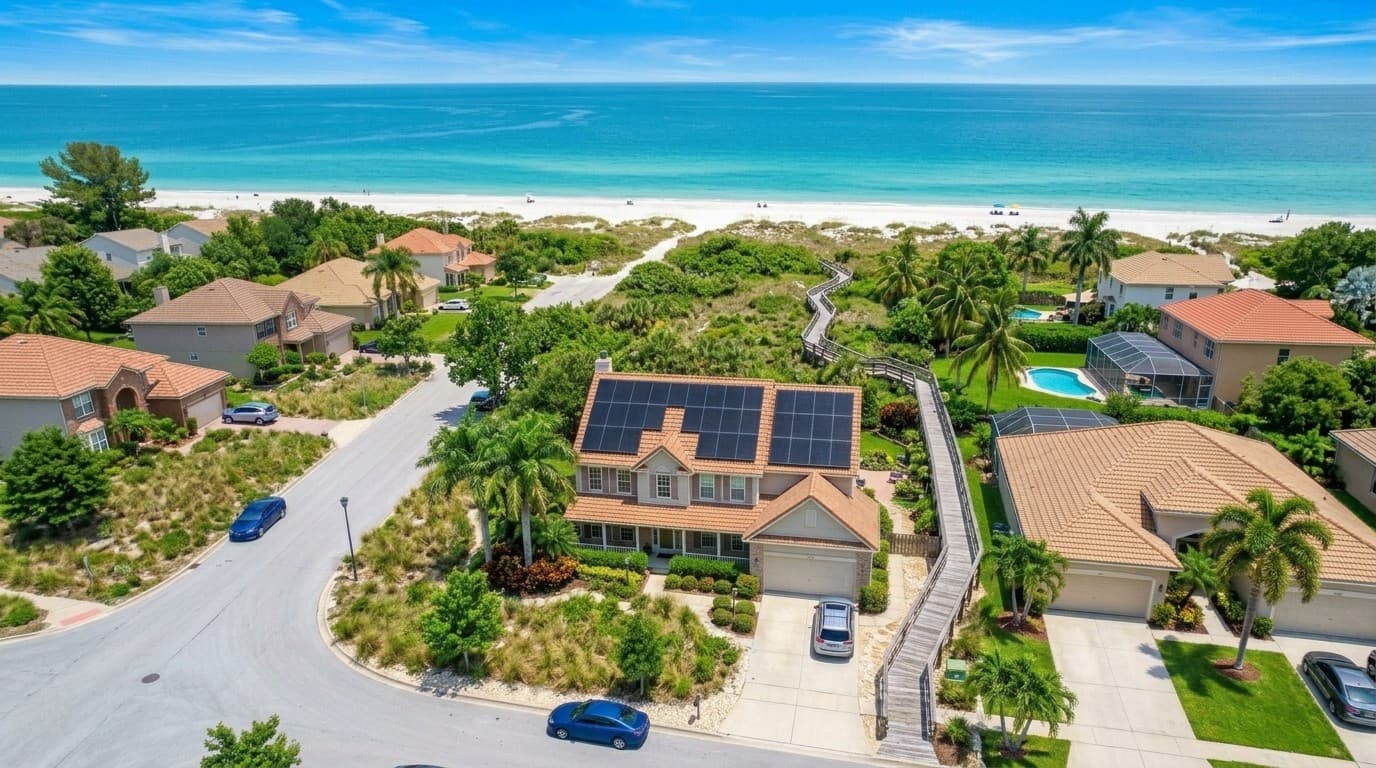
Solar panels in St. George Island, FL
See what solar and battery backup could save your St. George Island home on Duke Energy's rates, with full-retail net metering and $0-down options. Free, no-obligation quotes from installers serving Franklin County.
Free, no-obligation quotes. Savings vary by home and utility. $0-down offers are leases or loans and are subject to approval.
By the FL Solar Deals Editorial Team · Updated October 2026 · How we research
Quick answer
Is solar worth it in St. George Island, FL?
For many homes, yes. With a $200 monthly Duke Energy bill, we estimate a 9.2 kW system costs about $24,800 and pays for itself in about 12.6 years, because Duke Energy credits exported solar at the full retail rate. Panels in St. George Island produce roughly 1,440 kWh per kW each year on an unshaded, south-facing roof.
How much does solar cost and save in St. George Island?
- Electric utility
- Duke Energy
- County
- Franklin County
- Population (2020)
- about 1,000
- Solar output per kW
- ~1,440 kWh/year
- System for a $200/mo bill
- ~9.2 kW (23 panels)
- Typical Duke Energy rate
- ~14.9¢/kWh
- Est. cost / payback
- $24,800 / ~12.6 yrs
- 25-year savings
- $63,100
Estimates for a cash purchase on an unshaded, south-facing roof with a $200 monthly bill. Your roof and rate plan will change the numbers. How we estimate
| Town | Utility | Output per kW | System size | Cost | Payback |
|---|---|---|---|---|---|
| St. George Island | Duke Energy | 1,440 kWh | 9.2 kW | $24,800 | 12.6 yrs |
| Apalachicola | Duke Energy | 1,430 kWh | 9.2 kW | $24,800 | 12.7 yrs |
| Port St. Joe | Duke Energy | 1,430 kWh | 9.2 kW | $24,800 | 12.7 yrs |
| Mexico Beach | Duke Energy | 1,420 kWh | 9.6 kW | $25,900 | 12.8 yrs |
| Callaway | FPL | 1,410 kWh | 10.4 kW | $28,100 | 14 yrs |
What would a solar estimate look like for a St. George Island home?
Estimates for St. George Island homes at four common bill sizes. Bigger bills need bigger systems that cost more up front, but payback stays about the same, because every kWh the panels make is credited at Duke Energy's full rate. Homes that use more than 1,000 kWh a month pay a higher rate on the extra, so they often do a little better than shown.
| Monthly bill | System size | Panels | Roof space | Cost | Payback |
|---|---|---|---|---|---|
| $150/mo | 6.4 kW | 16 | ~340 sq ft | $17,300 | 12.6 yrs |
| $200/mo | 9.2 kW | 23 | ~480 sq ft | $24,800 | 12.6 yrs |
| $300/mo | 14.8 kW | 37 | ~780 sq ft | $40,000 | 12.6 yrs |
| $400/mo | 20.4 kW | 51 | ~1,070 sq ft | $55,100 | 12.6 yrs |
How does solar work with Duke Energy in St. George Island?
St. George Island is a Panhandle barrier island on Duke Energy Florida, many of whose homes are second homes, fed by a single transmission line across Apalachicola Bay.
Most homes in St. George Island get their electricity from Duke Energy Florida. Duke Energy net meters under the Florida PSC's rule: power your panels send to the grid comes back as a kWh credit at the full retail rate, credits roll forward for up to 12 months, and anything left at year-end is paid out at only a few cents per kWh. So the best St. George Island systems are sized to cover a year of use, not more. See the full Duke Energy solar guide.
Solar can't take your bill below Duke Energy's monthly minimum of about $30.
Is your St. George Island home a good fit?
About 98% of homes in St. George Island are owner-occupied, and the median owner-occupied home is valued at $693,000, compared with 68% and $359,000 statewide, according to the U.S. Census Bureau (2020-2024 estimates).
- You own the home. Rooftop solar requires owning the roof.
- Your roof gets sun for most of the day on its south, west or east side, without heavy tree shade.
- Your roof has years of life left. Replacing an aging shingle or tile roof before installing saves a removal and reinstall fee later.
- Your Duke Energy bill is regularly over about $150 a month, or you're adding an EV or a pool pump.
Not sure? A specialist can check satellite imagery of your St. George Island roof as part of your free quote.
How do I choose a solar company in St. George Island?
Check these before you sign with any solar company serving St. George Island:
- A Florida contractor license. Look up the company's license on the Florida DBPR license search and make sure it's active.
- Permits and utility paperwork included. The price should cover the permit with Franklin County, inspections and the Duke Energy net metering application.
- Two or three quotes compared on price per watt, equipment and warranties. Our solar quote checker flags high prices and other red flags, and our guide to choosing a solar company covers the rest.
Or request a free quote for your St. George Island home from one of our trusted Florida partners.
Can I add hurricane battery backup to solar in St. George Island?
Yes. A battery stores your solar power and keeps chosen circuits running when the Duke Energy grid goes down, which standard solar alone can't do: grid-tied panels shut off in an outage. After a storm, the panels recharge the battery each sunny day until the grid comes back. One 13.5 kWh battery runs about $13,000 installed at recent South Florida prices, with no utility or state rebate.
One battery usually covers essentials; running central air usually takes two or more. Because Duke Energy already credits exported solar at the full rate, a battery's value is backup, not a lower bill. See solar battery backup for hurricanes.
What permits and paperwork does solar need in St. George Island?
- St. George Island gets its power over a single 69 kV transmission line across Apalachicola Bay, which was rebuilt and reconductored around 2013. With one line in, a home battery is worth a look for storm season.
- Duke Energy Florida has a multiyear grid improvement project on the island, done in phases beginning in 2023, including upgrades to its St. George Island substation.
- Building seaward of Franklin County's coastal construction control line requires a permit from the Florida Department of Environmental Protection, which matters for ground mounts or new structures on Gulf-front lots. Hurricane Idalia in 2023 caused minor flooding on the island's north side.
- 1
Building permit
Your installer applies to Franklin County for the permit, with plans designed to Florida Building Code wind loads, and an inspector checks the finished work. Since July 2025, state law lets a private provider review residential solar and battery plans, with a decision due within 5 business days.
- 2
Duke Energy net metering application
Your installer applies to Duke Energy to connect the system. Most home systems are Tier 1 (up to 10 kW), with no application fee.
- 3
Meter swap and permission to operate
After the final inspection, Duke Energy installs a net meter and gives permission to turn the system on.
- 4
Property tax
Florida law keeps the value solar adds out of your home's assessment. If you're unsure whether anything needs to be filed, ask the Franklin County Property Appraiser.
Local sources: Florida PSC: Storm hardening report including the St. George Island transmission line (2013); Duke Energy: St. George Island grid improvements; Florida Administrative Code R. 62B-26.014: Franklin County coastal construction control line; WJHG: Franklin County minimally impacted by Hurricane Idalia (Aug. 2023)
How much could solar save your St. George Island home?
Get an instant solar estimate for your St. George Island home: enter your bill to see a system size, cost, payback and what battery backup adds.
Your estimate
- System size
- 9.2 kW
- about 23 panels
- Yearly production
- 13,248 kWh
- vs. about 13,691 kWh used
- First-year savings
- $1,974
- about $165/month
- Payback
- 12.6 years
- $63,100 saved over 25 years
| Estimated costNo Florida state or utility rebate applies; sales tax is already exempt. | $24,800 |
|---|
Planning estimate only, not a quote. Assumes a south-facing roof, a cash purchase and a system sized to cover up to a year of use. Real numbers depend on your roof, equipment and rate plan. How we estimate
How it works
- 1
Enter your ZIP
We confirm your home is in Florida and which utility serves it.
- 2
Answer a few questions
Your typical electric bill, your roof and how you'd like to pay. It takes about two minutes.
- 3
Talk to a local specialist
A Florida installer models your real savings from your bills and roof, with battery backup if you want it. You decide what happens next.
Where else near St. George Island can you get solar quotes?
What should St. George Island homeowners know before going solar?
St. George Island solar FAQ
Who is the electric utility in St. George Island, FL?
Most homes in St. George Island are served by Duke Energy Florida. Some addresses near town edges may be on a city-owned utility or an electric co-op, so check the name on your bill.
Are there solar rebates in St. George Island?
Not from the state or Duke Energy. What St. George Island homeowners do get is full-retail net metering from Duke Energy, no sales tax on solar equipment, and no property tax on the value solar adds to the home. The 30% federal homeowner credit ended after 2025.
How much do solar panels cost in St. George Island?
For a home with a $200 monthly bill, we estimate a 9.2 kW system at about $24,800, which pays for itself in about 12.6 yrs. A lease can bring the upfront cost to $0. Try the solar savings calculator, or get a free quote for real numbers on your St. George Island home.
How much electricity do solar panels produce in St. George Island?
About 1,440 kWh per year for each kW of panels on an unshaded, south-facing roof, so a 9.2 kW system would make roughly 13,248 kWh a year. Shade, roof direction and pitch can lower that.
Will solar keep my power on during a hurricane in St. George Island?
Only with a battery. Grid-tied panels shut off when the Duke Energy grid goes down, for the safety of line crews; a battery keeps chosen circuits running and the panels recharge it each sunny day.
Can my HOA in St. George Island stop me from going solar?
No. Florida law bars HOAs and deed restrictions from prohibiting solar panels. The association can choose where on the roof they go, as long as the spot faces south or within 45° east or west of due south and doesn't keep them from working well.
Get a free solar quote for your St. George Island home
Free, no-obligation quote from a trusted Florida solar partner.