Quick answer
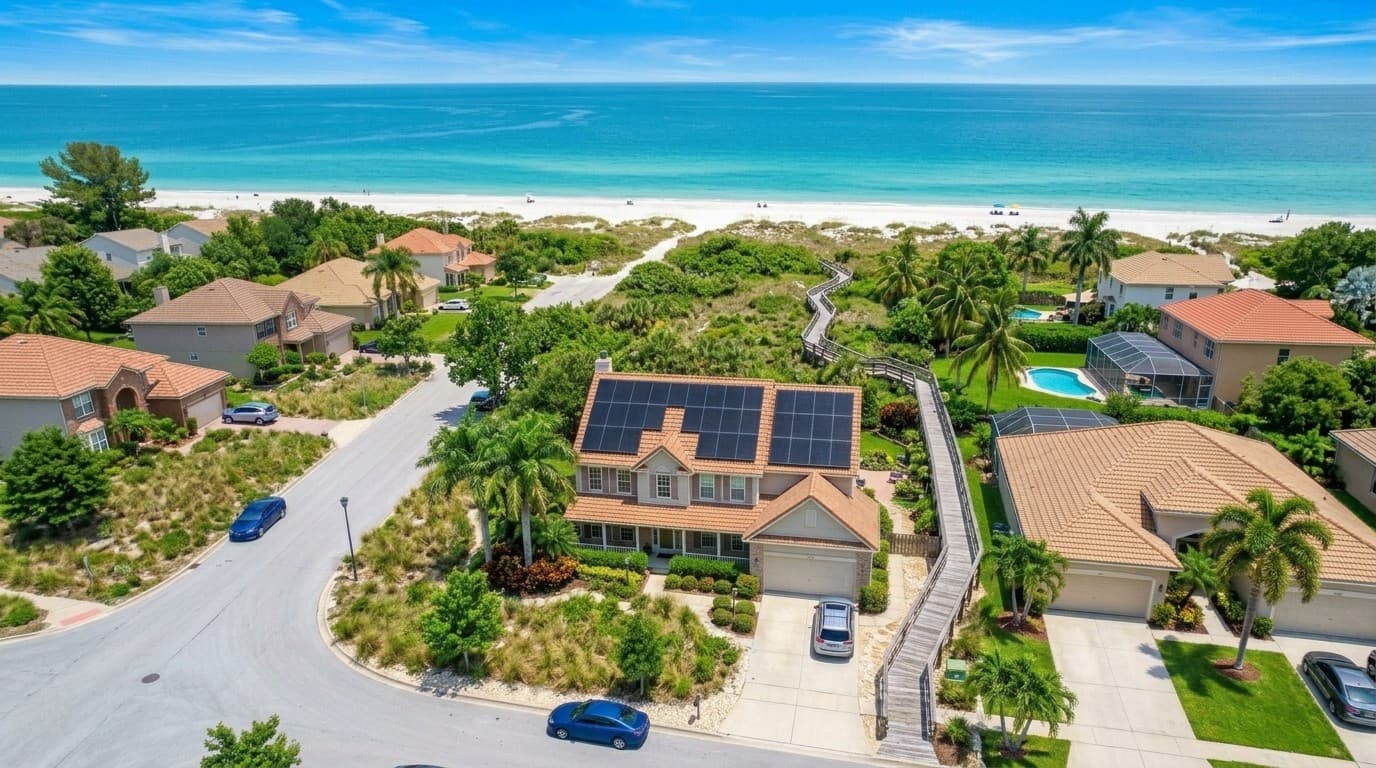
Solar can work well on a Florida second home. Net metering credits from months you're away carry forward for up to a year and offset the months you're there, and the AC still has to run all summer to control humidity. Leftover credits at year-end pay only a few cents per kWh, so size for your yearly use. Second homes also get the solar property tax exclusion.
Does solar make sense if I only live in Florida part of the year?
Usually, yes. Under Florida's net metering rule, extra solar you send to the grid earns kWh credits that carry forward month to month for up to 12 months. Credits you build up while you're away offset the power you use when you're back in the same calendar year.
At the end of the year, unused credits are paid out at the utility's as-available energy rate, only a few cents per kWh, not the full retail rate. FPL applies that credit to the December bill. So size the system for your home's full year of use rather than to produce as much as possible.
See Florida net metering and how many solar panels you need.
Why does an empty Florida home still use power in summer?
Humidity. The EPA recommends keeping indoor humidity below 60%, ideally 30% to 50%, to prevent mold. Florida Solar Energy Center studies of vacant Florida homes found that letting the house float with no air conditioning left humidity around 70%, while running the AC for two hours before dawn kept it under control.
FPL's 2026 tips for snowbirds suggest cooling to 72°F for two hours before sunrise and setting 88°F for the rest of the day, or 80°F on a non-programmable thermostat. That summer cooling is exactly when solar produces the most, so the panels keep working for you while you're gone.
Will solar take my second home's bill to zero?
Not quite. FPL and Duke Energy Florida have a $30 minimum bill, and Tampa Electric charges a basic service charge of about $0.45 a day, even on days you use no power. Solar covers the energy part of the bill, not these fixed charges.
See why your FPL bill is so high for how the rest of the bill works.
Does a second home get Florida's solar property tax break?
Yes. Under s. 193.624 of the Florida Statutes, the value solar adds can't be counted in the assessment of real property used for residential purposes, and the law doesn't require a homestead. Second homes don't get the homestead exemption or Save Our Homes cap, but they do get a cap on yearly assessment increases for non-school taxes, with no application needed. That cap is 10% today; Amendment 3, which voters approved in November 2026, lowers it to 5% from January 1, 2027.
How does a battery protect a home while I'm away?
Hurricane season runs June 1 to November 30, the months many owners are up north. Enphase's Storm Guard watches National Weather Service alerts and charges the batteries automatically before a storm, and it's on by default. Tesla's Storm Watch charges Powerwall to full when severe weather is forecast.
If the grid goes down, a battery can keep the refrigerator, internet and air conditioning running, which helps keep humidity in check until power returns. You can watch the system from the app. See the best home batteries for Florida and solar and batteries in a flood zone.
What about insurance on a seasonal home with solar?
Tell your insurer about the solar system and how often the home is empty. Citizens Property Insurance, for example, calls a home seasonal if it's unoccupied for three or more consecutive months in a policy year, and secondary if it isn't your primary home but is empty for shorter stretches. See solar and home insurance in Florida.
What should I do before leaving for the summer?
- Set the thermostat for humidity control, as FPL suggests, rather than turning the AC off.
- Turn off the water heater at the breaker, as FPL recommends.
- Check that the solar monitoring app is reporting and that the battery's storm mode is on.
- Leave your installer's contact and the system's shutoff location with whoever checks on the house.
- Have trees near the roof trimmed before hurricane season.
Sources
- Florida Administrative Code Rule 25-6.065: Interconnection and net metering of customer-owned renewable generation
- FPL: Net metering FAQ
- U.S. EPA: A brief guide to mold, moisture and your home
- Florida Solar Energy Center: Humidity control in vacant Florida homes
- WUSF: FPL tips for snowbirds leaving for the summer (Apr. 2026)
- Palmetto: Florida utility guide (net metering and minimum bills, 2026)
- Tampa Electric: Residential rates insert, January 2026
- Tampa Electric: Understanding your bill
- Florida Statutes s. 193.624: Assessment of renewable energy source devices
- Palm Beach County Property Appraiser: Assessment caps
- Pinellas County Property Appraiser: Save Our Homes
- NOAA: 2026 Atlantic hurricane season outlook (May 2026)
- Enphase: Storm Guard, charging ahead of severe weather
- Tesla: Powerwall and Storm Watch
- Citizens Property Insurance: Seasonal and secondary home definitions
- Bay News 9: Florida voters approve Amendment 3, property tax relief for homeowners (Nov. 2026)
- Decision Desk HQ: 2026 Florida Amendment 3 results
This guide is general information, not tax, legal or financial advice. Incentive programs change, so confirm current terms with your installer, your utility and a tax professional.