Quick answer
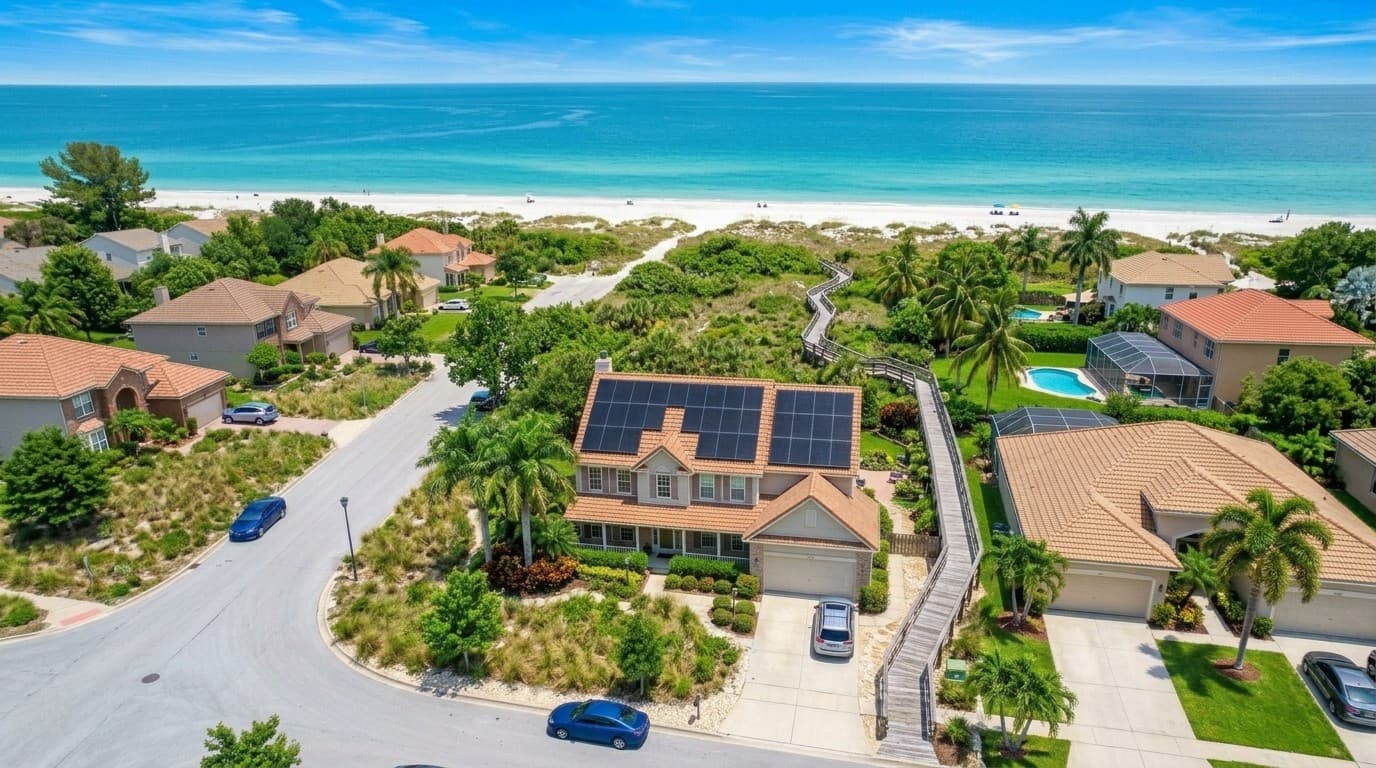
Usually, yes, with approval. Florida's solar rights law (s. 163.04) bars local rules that prohibit or have the effect of prohibiting solar, and it has no historic-district exception. But cities with historic districts still require a certificate of appropriateness, and boards often steer panels to rear or side roof slopes. No Florida court has said how far the law reaches against historic review.
Can you put solar on a historic home in Florida?
In most cases, yes, but not wherever you like. If your home is a local landmark or sits in a local historic district, the city reviews exterior changes, solar included, before it issues a building permit. Boards mostly judge solar against the federal Secretary of the Interior's Standards for Rehabilitation.
The National Park Service, which writes guidance on those standards, says panels placed where they can't be seen from the ground will generally meet them. It also warns that for some historic buildings it may not be possible to add panels and meet the standards, and that every project is judged on its own merits. In practice, Florida boards approve many systems once the panels move off the most visible slope.
Does Florida's solar rights law apply in historic districts?
Florida's solar rights law, s. 163.04, says a city or county can't adopt an ordinance that prohibits, or has the effect of prohibiting, solar collectors, and the statute doesn't carve out historic districts. But no Florida court or Attorney General opinion has said how far that reaches against historic design review. Cities with historic districts still require a certificate of appropriateness, and many steer panels away from street-facing slopes.
- A 1983 appeals case: in City of Ormond Beach v. Del Marco, a case about a windmill and a zoning variance, not a historic district, Florida's Fifth District Court of Appeal applied the law to a city board. It also said the owner couldn't place the device wherever he pleased; the question was whether the rule prohibited it from working, not whether it got the best possible spot.
- Coral Gables' own reading: a 2016 opinion from the Coral Gables city attorney found that s. 163.04(1) applies to the city but concluded that its Board of Architects review is still enforceable, partly because that review predates the statute. That is the city's position, not a court ruling.
- The HOA placement rule is separate: the better-known rule letting an association pick the spot, within 45° of due south, is aimed at homeowners associations. See Florida HOA solar rules.
The practical takeaway: treat the review as something to work with, not around. A design the board can approve is usually faster than a legal fight nobody has tested.
Which Florida cities review solar on historic homes?
| City | Utility | Who reviews | What the city's records show |
|---|---|---|---|
| Coral Gables | FPL | Board of Architects; Historic Preservation Board or staff for Register properties | Panels on pitched roofs may be permitted with Board of Architects approval; flat-roof parapets are used to screen them |
| Tampa | TECO | Architectural Review Commission (Hyde Park, Tampa Heights and other districts) | Tampa Heights guidelines say solar collectors should not be visible from the street |
| St. Augustine | FPL | Historic Architectural Review Board | Exterior changes in the HP-1 to HP-5 districts need board approval under the city's architectural guidelines |
| St. Petersburg | Duke Energy | Staff or the preservation commission | A certificate of appropriateness is required before exterior changes to a local landmark or property in a local historic district |
| Miami Beach | FPL | Historic Preservation Board | The board reviews alterations and improvements within historic districts |
| Palm Beach | FPL | Architectural Commission (ARCOM) | ARCOM has heard applications to add rooftop solar to existing homes |
| Boca Grande | FPL | Historic Preservation Board | In 2024 the board approved two rooftop projects with panels behind the street view of the house |
Town pages cover the local details: Coral Gables, Tampa, St. Augustine, St. Petersburg, Miami Beach, Palm Beach and Boca Grande. Other FPL and Duke towns with historic review include Boynton Beach, Delray Beach, DeLand and Pensacola.
Where do historic boards usually allow panels?
- Rear and side slopes: the Park Service recommends panels on roof areas not visible from the primary elevation, and Florida boards often approve panels behind the street view.
- Flush, low-profile mounts: the Park Service recommends mounting panels flat or parallel to the roof to reduce visibility.
- Flat roofs behind parapets: Coral Gables uses parapets on flat roofs to screen solar. See solar on a flat roof in Florida.
- Off the house entirely: a ground-mounted array in a screened rear yard, or a solar pergola or carport, can avoid altering the historic roof at all.
- Tile roofs: if your historic home has a clay or concrete tile roof, mounts that replace or work around tiles without removing historic roof features are easier to defend. See solar on a tile roof in Florida.
What boards dislike: removing or altering historic roof features, arrays that harm the property's character, and installations that can't be reversed. One tradeoff to plan for: the south- or west-facing slope that produces the most power is sometimes the one facing the street. A rear slope may need a few more panels for the same output, so ask your installer to model each option in the solar savings calculator or their design software.
What should you bring to the historic review?
- 1
Call the preservation office first
Ask whether your home is a local landmark or in a local district, whether staff can approve solar, and which application and meeting deadline apply.
- 2
Bring a roof plan
Show every panel on a roof plan, with the street-facing slopes marked, and explain why you chose the slopes you did.
- 3
Bring photos from the street
Photos or simple renderings from the sidewalk show the board how much of the array, if any, can be seen.
- 4
Bring the equipment sheets
Include panel and racking spec sheets showing panel color, flush mounting and how the mounts attach to the roof covering.
- 5
Show it can be undone
Explain how the system comes off later without damaging historic roof features.
- 6
Have a fallback layout
Bring a second option, such as a rear slope, ground mount or pergola, in case the board asks for changes.
A local installer who has been through your city's review before can prepare most of this. See how to choose a solar company in Florida.
How long does a certificate of appropriateness take?
It depends on whether staff can sign off or the full board has to hear it. No city we checked publishes a total timeline, but the steps are public:
- Tampa: the ARC/BLC administrator can approve certain scopes of work without a public hearing, and the 2026 fee schedule lists residential staff approval at $30. Solar has also gone to a full hearing: the December 3, 2025 agenda included solar collectors on a Tampa Heights home.
- St. Augustine: applications follow a set calendar about a month before each board meeting (for example, a December 16, 2025 deadline for the January 15, 2026 meeting) to meet state legal notice rules, and historic review comes before the building permit.
- St. Petersburg: fees differ for staff review and commission review, and applications that need a public hearing are scheduled in the order received.
Small changes are often approved by staff, which can be quick; anything a board must hear waits for its next meeting and the notice deadline before it. See how long solar installation takes in Florida for the rest of the timeline.
Will solar affect a historic property's tax breaks?
- Local historic property exemption (s. 196.1997): Florida lets counties and cities exempt up to 100% of the assessed value of qualifying improvements to historic properties from property tax. The owner signs a covenant to keep the property's historic character for the term of the exemption, and improvements must meet the Secretary of the Interior's Standards. If your home has one, ask the county or city preservation office before adding visible panels.
- Federal 20% historic tax credit: it doesn't apply to your own home. The Park Service says owner-occupied residential properties don't qualify; the credit is for income-producing buildings.
- Florida's solar tax breaks: the sales tax exemption on solar equipment and the property tax exclusion for the value solar adds are set by state law, and nothing we found says historic status changes them. See solar and property taxes in Florida and Florida solar incentives.
Sources
- Florida Statutes s. 163.04: Energy devices based on renewable resources (solar rights)
- National Park Service: Solar panels on historic properties
- National Park Service: ITS 52, Incorporating solar panels in a rehabilitation project
- National Park Service: Guidelines on sustainability for historic buildings, solar technology
- City of Ormond Beach v. State ex rel. Del Marco, 426 So. 2d 1029 (Fla. 5th DCA 1983)
- City of Coral Gables: City Attorney Opinion CAO 2016-020, Solar array (Mar. 31, 2016)
- City of Coral Gables: Solar, open air dining and other permits
- City of Coral Gables: Preserving our past (historic preservation guide)
- City of Tampa: Tampa Heights design guidelines (solar collectors)
- City of Tampa: ARC/BLC application submission requirements
- City of Tampa: 2026 fee schedule
- City of Tampa: Architectural Review Commission public hearing agenda (Dec. 3, 2025)
- City of St. Augustine: Historic Architectural Review Board applications and deadlines
- City of St. Petersburg: Certificate of Appropriateness application package
- City of Miami Beach: Historic Preservation Board
- Town of Palm Beach: ARCOM agenda item ARC-24-0093, solar panels at 1240 N Ocean Way
- Boca Beacon: Historic Preservation Board approves four projects (Sept. 2024)
- Florida Statutes s. 196.1997: Ad valorem tax exemptions for historic properties
- St. Johns County: Resolution 2023-417, historic property exemption covenant
- National Park Service: About the federal historic tax incentives
- Florida Statutes s. 193.624: Assessment of renewable energy source devices
- Florida Department of Revenue: Tax Information Publication 19A01-09, sales tax exemption for solar energy systems
This guide is general information, not tax, legal or financial advice. Incentive programs change, so confirm current terms with your installer, your utility and a tax professional.